
Small Bathroom Lighting: Why Overhead Vanity Lights Cast Unflattering Shadows

You step into the bathroom first thing in the morning, flip the wall switch, and catch your reflection in the mirror. Suddenly, you look exhausted. Dark hollows sit beneath your eyes, fine lines appear deeper than they were yesterday, and a heavy shadow stretches beneath your chin and nose. Before you blame a rough night of sleep or reach for an expensive eye cream, look up. That harsh, unforgiving reflection usually has nothing to do with your skin and everything to do with a single, poorly placed light fixture mounted right above your mirror.
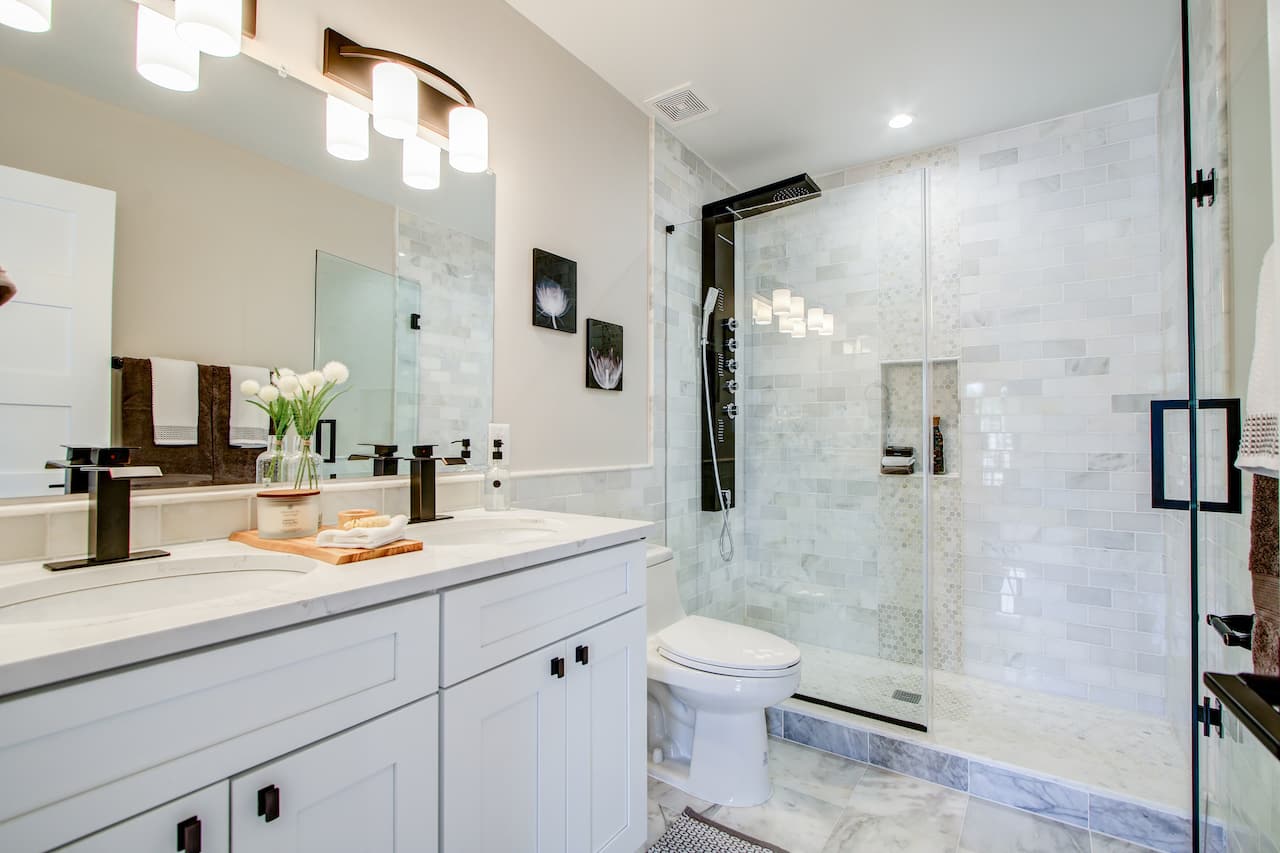
In small bathrooms across the country, the single overhead vanity bar remains the default builder-grade choice. Contractors favor it because it requires just one electrical junction box, keeps installation costs low, and floods a compact footprint with plenty of raw brightness. Yet when it comes to the primary tasks you perform at a bathroom sink—shaving, applying makeup, tweezing, or checking your appearance before heading out the door—overhead lighting works against basic human anatomy.

The Physics of Downward Light on a Human Face

To understand why overhead vanity lights fail so spectacularly, think about how light interacts with three-dimensional surfaces. A human face is not a flat canvas. It has pronounced ridges and recesses: the brow bone, the bridge and tip of the nose, the cheekbones, the lips, and the jawline.
When a light source sits high above your head and shines straight down, those protruding features act like miniature awnings. Your brow ridge blocks light from reaching your eye sockets, casting dark pools directly under your eyes. Your nose throws a triangular shadow across your upper lip, while your lower lip and chin cast shadows down onto your neck. Instead of illuminating your face evenly, top-down lighting exaggerates every crease, pore, and contour.
In a large bathroom with high ceilings and multiple ambient fixtures, light bounces off distant walls and ceilings to soften some of those harsh angles. A small bathroom offers no such mercy. Tight quarters mean you stand much closer to the mirror and the wall, putting yourself directly underneath the beam spread of the fixture. The steeper the angle of the light hitting your face, the longer and darker those facial shadows become.

Why Small Bathrooms Magnify the Problem

Compact bathrooms—whether a narrow powder room, an apartment bath, or a cramped en-suite—create unique optical challenges that make single-source lighting even less forgiving.
First, limited wall space restricts where fixtures can physically go. Many small vanities sit wedged between a wall on one side and a shower enclosure or toilet on the other. Without extra inches flanking the mirror, builders default to the only open real estate left: the strip of drywall between the top of the mirror and the ceiling.
Second, surface finishes in tight spaces often skew light back in unpredictable ways. Glossy ceramic tile, large frameless mirrors, and bright white paint bounce light rapidly around a small box. If your overhead fixture uses exposed clear glass shades or bare bulbs, that intense glare reflects straight off the porcelain sink and back into your eyes, forcing your pupils to constrict while leaving the lower half of your face in relative darkness.

Cross-Illumination: The Gold Standard for Vanity Lighting

Professional lighting designers and makeup artists rely on a simple principle to eliminate facial shadows: cross-illumination. Instead of pushing light down from above, cross-illumination delivers even, diffused light from both sides of the face at eye level.
When light hits you horizontally from the left and right simultaneously, the beams overlap across the center of your face. The nose no longer casts a side shadow, eye sockets receive direct, gentle fill light, and the jawline stays cleanly defined without heavy dark patches underneath.

Mounting Sconces on Either Side of the Mirror

The cleanest way to achieve cross-illumination is by installing a pair of vertical wall sconces flanking the mirror. For the best results, follow a few proven placement rules:
  • Set the height at eye level: Position the center of each sconce roughly 60 to 65 inches above the finished floor. If people of noticeably different heights share the bathroom, aim for the average eye line or choose longer linear sconces that distribute light across a wider vertical span.

  • Space them properly: Mount the fixtures 28 to 36 inches apart, typically just outside the edges of the mirror. If a wide vanity mirror prevents side wall mounting, you can actually mount sconces directly onto the mirror glass itself—a clean, modern look that doubles the perceived light output.

  • Choose frosted or white glass shades: Clear glass and exposed Edison bulbs look stylish in catalog photos, but they create blinding hotspots in a tiny room. Milky white, opal, or frosted shades diffuse light evenly, wrapping your face in soft brightness without harsh glare.

What to Do When Side Wall Space Does Not Exist

In many small bathrooms, flanking sconces simply will not fit. Maybe your medicine cabinet spans the entire width of a 24-inch vanity, or a side wall butts right up against the edge of the sink. Fortunately, you still have strong alternatives to a harsh overhead bar.
Backlit and front-lit LED mirrors have transformed small bathroom design over the past several years. Because the light source is integrated directly into the perimeter of the glass, an illuminated mirror delivers the exact same shadow-free cross-illumination as side sconces without requiring an extra millimeter of wall width. Look for models that project light forward through frosted bands on the glass rather than ones that only glow softly behind the frame, as back-only glow rarely provides enough task brightness for grooming.
If you must keep an overhead fixture above the mirror, choose a long linear bar that spans at least 75 percent of the mirror’s width rather than a compact two-light cluster huddled in the center. Mount it as low as the mirror frame allows, and pick a fixture with a wide, cylindrical frosted diffuser that directs light outward into the room rather than straight down onto the crown of your head.

Getting Bulb Specs Right: Color Temperature, CRI, and Brightness

Even the best fixture placement falls flat if you screw in the wrong bulbs. Small bathrooms exaggerate poor light quality because you are standing inches away from the source.

Color Temperature (Kelvin)

Avoid harsh, clinical blue-white bulbs rated at 5000K or higher, which make skin look washed out and emphasize redness. On the flip side, ultra-warm 2200K bulbs cast a heavy yellow-amber tint that distorts makeup colors and makes a small room feel dim. Aim for a sweet spot between 2700K and 3000K for warm, flattering residential light, or up to 3500K if you prefer a crisp, neutral daylight feel that still keeps skin tones natural.

Color Rendering Index (CRI)

CRI measures how accurately a light source reveals true colors compared to natural sunlight on a scale from 0 to 100. Standard budget LED bulbs often sit around 80 CRI, which drops off in the deep red spectrum—the exact wavelengths needed to make human skin look healthy and vibrant. Always upgrade to bulbs or integrated LED fixtures rated at 90 CRI or higher for your vanity.

Lumen Output

In a small bathroom, aim for roughly 1,500 to 2,000 total lumens at the vanity, split evenly between your left and right fixtures. Pairing those bulbs with a compatible wall dimmer gives you bright, energetic visibility for morning routines and a calm, low-glare glow late at night.

Layering Light in a Compact Footprint

Finally, remember that your vanity lights should not carry the entire room on their own. When the mirror fixtures are the sole light source in a small bathroom, they have to work overtime, creating sharp contrast between the bright sink zone and darker corners near the shower or toilet.
Adding a single recessed downlight—rated for damp or wet locations—centered in the ceiling or above the shower balances the ambient light across the entire room. When ambient ceiling light and eye-level vanity light work together, shadows soften across every angle, turning a cramped, unflattering bathroom into a space where you actually look forward to checking the mirror.

Comments are closed.